
Introducing Naveni® Plex
Naveni® Plex enables simultaneous detection of 3 separate targets or protein-protein interactions with high specificity, sensitivity and resolution. It’s a ready-to-use kit with seamless integration with standard IF workflows.
The next generation in situ proximity ligation assay
Introducing Naveni® Plex
Naveni® Plex enables simultaneous detection of 3 separate targets or protein-protein interactions with high specificity, sensitivity and resolution. It’s a ready-to-use kit with seamless integration with standard IF workflows.
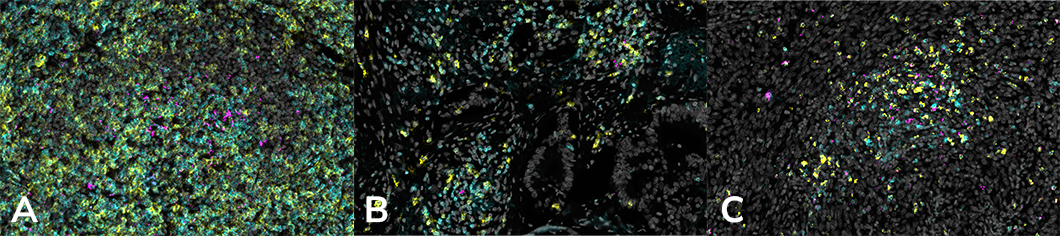
Uncover complex protein interactions in the tumor microenvironment with Naveni® Plex, the groundbreaking isPLA multiplex solution designed to simultaneously detect a combination of:
- PD1/PD-L1 and PD1/PD-L2 interactions – illuminating activated immune checkpoint pathways
- PD1/SHP-2 interactions – revealing whether or not down-regulation of T-cells can occur
- CD8/MHC-I interactions – revealing initiation of critical T-cell activation processes
- CD3 presence – tracking a key T-cell marker
Understand immune evasion and mechanisms
Estimate T-cell infiltration (CD3, CD8), cytotoxic engagement (CD8/MHC-I), and inhibitory checkpoint activity (PD-1/PD-L1, PD-1/PD-L2, and PD-1/SHP2) to determine how immune evasion mechanisms modulate the function of infiltrating T cells.
Workflow
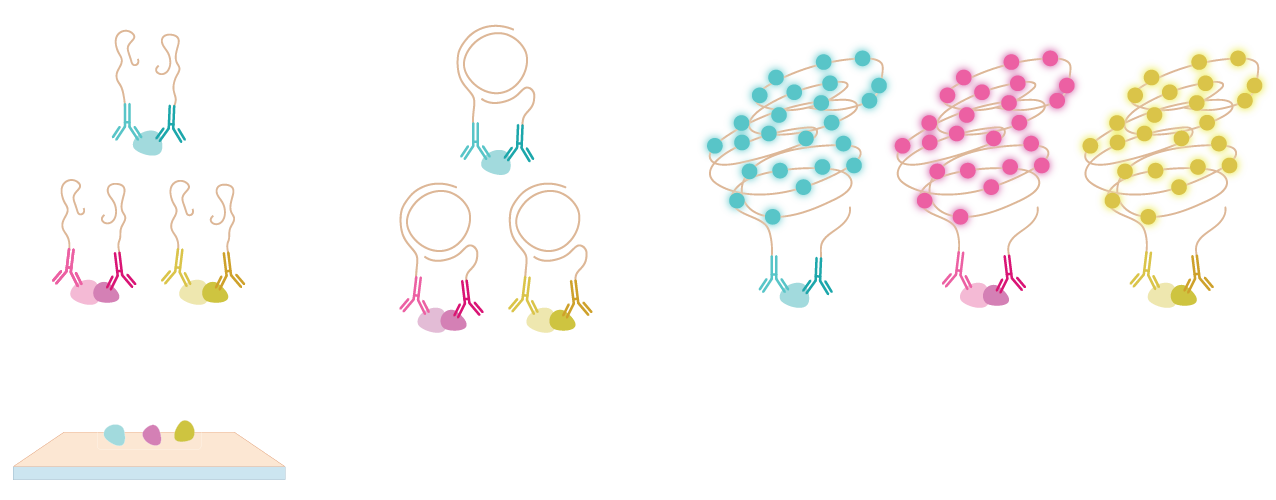
Step 1
Navenibodies bind to their target proteins
Step 2
Proximally bound Navenibodies connect through a circularized DNA ”bridge”
Step 3
The connector DNA is amplified and detected by multiple fluorescently labeled oligos
Naveni® Plex kit
Naveni® Plex is the first multiplex in situ proximity ligation assay, with a fluorescent readout, enabling the simultaneous detection of 3 separate targets, protein–protein interactions and/or single protein expression, with high specificity and sensitivity. The kit has been validated on FFPE human tissue samples.

Multiplex isPLA providing functional proteomics
Mapping multiple protein interactions simultaneously in the cancer immune interface, going beyond expression to reveal functionality.
Optimized and ready to use
Curated and validated protein targets for improved understanding of the immune landscape in tissue.

Enhanced sensitivity & specificity
Dual antibody recognition with signal amplification ensures precise detection of even the most challenging targets in a multiplex setting.
Omni Service
Ready to dive even deeper into multiplex interactomics? With the Omni Service, you can explore up to nine protein–protein interactions using fully customizable panels designed around your specific scientific questions.